
We all aim to live a good life. But we have different ideas about what constitute a good life. These different ideas lead us to take different routes and strive for different things in our life.
For some people a life of unlimited pleasures is a good life, and so they spend their lives seeking pleasures.
Some people find happiness in their work, so they devote their lives to their work.
Whereas, pursuit of wealth plays a key role in many people’s life.
But what is the goal or purpose that is best for all?
For Aristotle the highest good for a thing is determined by its nature or function.
For example, if we want to know what’s the highest good of a knife, we have to understand the essential nature of a knife. Because the highest good or function of anything depends on the essence of that thing. So what’s the essential nature of a knife? We know that a knife is an object which has a handle and a blade. We also know that the blade is an essential part of a knife as without blade we can hardly call an object a knife. For this reason, the function of a knife will depend on its essential part, which is, its blade. And the purpose of a blade is to cut things. So the function of a knife will also be to cut owing to its essence. So the highest good of a knife will be to cut well.

In the same way, if we want to know what is a good life for human beings. We have to look into the nature of human beings. What is the essence of humans? What differentiates a human being from all the other beings? Aristotle comes to the conclusion that human beings are essentially rational beings. This means the capacity for reasoning is the defining feature of human beings, and it is the capacity for rational thinking that differentiates us from all the other beings. So the highest good for human beings will be to live their life in accord with reason.
But how can we live our lives in accord with reason?
Aristotle thinks that our lives should be governed by reason. But he doesn’t mean that we all should live like intellectuals rather he presents a comprehensive picture of a good human life in his book Nicomachean Ethics.
Aristotle’s answer is very much inspired by nature. He found that there is a teleological principle in nature. Telos is a Greek word which means goal or purpose. Aristotle saw that in nature everything has a purpose, a goal, an aim for which that thing strive. The purpose of a seed is to become a tree, and to give flowers and fruits. Aristotle tell us that in the same way, the ultimate end or purpose of human life is to achieve eudaimonia.

The literal translation of the Greek word ‘eudaimonia’ is ‘happiness’. But eudaimonia means more than just happiness. It is the highest human good that each individual desires for its own sake and not for the sake of something else.
For example, we seek wealth, reputation, pleasures because we think possession of these things will make us happy. The end goal of each desire is to become happy.
Eudaimonia is attained when a person lives a good life and flourishes in his life. It is the utmost happiness that comes from the realization of a well-lived life.
So how can we achieve eudaimonia?
First of all, there are certain external goods that a person must have in order to live a happy life. These goods include friends, family, honor, good health, and wealth. It is thought that a person can’t live a happy life without them. So a good life very much dependent on the luck of a person, as well.
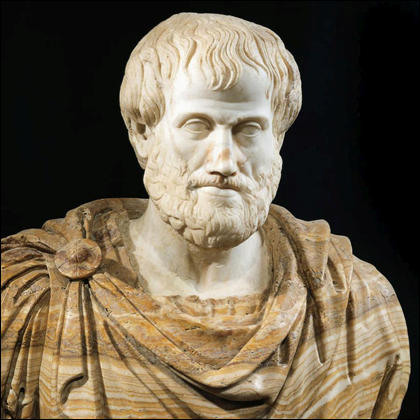
Secondly, a person must develop an excellent character for living a happy life. Because for Aristotle only virtuous people can live a good life. But how can we become virtuous or how can cultivate virtues of character?
A virtuous person, for Aristotle, is a person who possess a set of character virtues. For example, virtues like courage, temperance, justice, prudence and so on. These virtues are essential for living a good life. In other words, you can’t live well if you don’t have these virtues.
A person can become virtuous by acting virtuously. This means we can become courageous if we start acting courageously in all situation that requires courage. In this way, courage will become part of our character. So to cultivate virtues of courage, temperance, prudence and so on, we have to constantly practice these virtues.
A person wouldn’t be called generous who once showed generosity. A generous person, on the other hand, is one who act generously in all situation that require generosity. In other words, it is the nature of generous person to act generously.
A virtuous person doesn’t have difficulty in acting virtuously, as acting virtuously is part of the character of that virtuous person. So we should not bother about which actions are right or wrong. We should focus on cultivating a virtuous character. Once we have a virtuous character, we would do what is right without even thinking.
So to live a good life, one should strive to become good. Becoming good requires that we seek what is good and try to practice those goods until we achieve excellence of character. This way we may achieve what is our ultimate goal, eudaimonia.
 Everyday Philosophy
I believe as Aristotle said, that the good life is the effort to achieve the ultimate goal, the eudaimonia. Eudaimonia, as the text highlights is not only happiness. It’s the highest human good that each individual desires for its own sake and not for the sake of something else.
I wanted to ask to which extent pleasures (of the soul and body) are part of eudaimonia?
LikeLiked by 1 person
Eudaimonia is the final end or purpose of human existence, like flowering and fruitation is of seeds. We can attain eudaimonia if we have a balanced character. Having a balanced character involve avoiding the extremes. In the case of pleasure, if we totally deprive ourselves of pleasure, we would become insensitive. On the other hand, if we exercise too much pleasure, we would become indulgent. The golden mean would be to show temperance. If we practice temperance then we would develop a virtue of temperance which would help us in attaining eudaimonia.
LikeLike
[…] Are you living a good life? […]
LikeLike