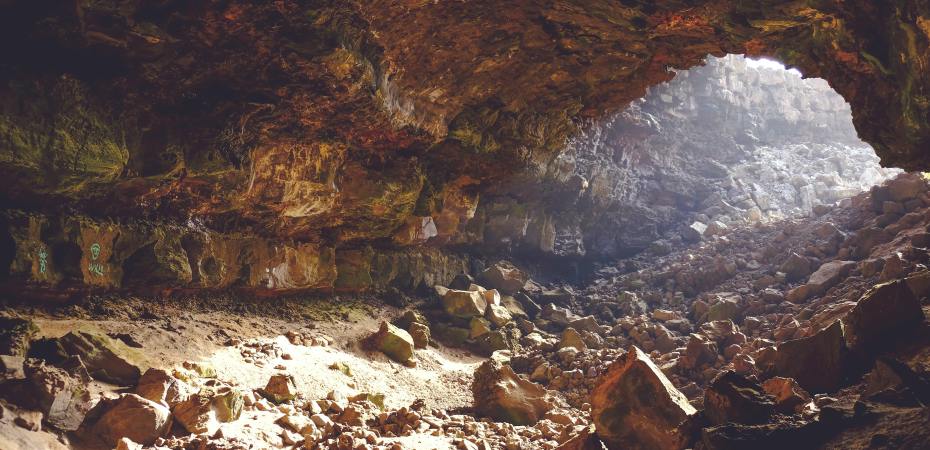
Plato described the conditions of our life in the world through his famous allegory of cave. In the allegory of cave the humanity is depicted as chained with a wall in a cave in such a way that they can’t move their heads. Behind the wall there is a fire burning. What people can see is a wall that is in front of them and on the wall different shadows appear of things that pass behind them by the fire.
People who are chained argue about the shadows that appear on the wall. For instance, one say a given shadow is a goat, another say it’s a cow. They keep arguing among themselves about the shadows.
But one day a person somehow succeeds in freeing himself from the shackles and escapes the cave. When he comes out of the cave he gets blinded by the broad daylight. After a time his eyes recovers and he comes to see everything in the clear light of sun. He sees everything in its true colors for the first time. He realizes that the things that they used to argue in the cave were merely shadows of real things.
He goes back to the cave to break the exciting news to his fellow cave dwellers. But when he enters the cave his eyes gets blinded again because of the darkness. After a time his eyes become able to see in the dark. He tells his fellows that the things they fight over were merely shadows, but they don’t understand what he is talking about, and so they declare him insane.
Through this allegory Plato showed that most people are like cave dwellers because they fight over appearances. While none of them is able to see the reality. Plato made a distinction between world that appears to us through our senses and the world that exist independently in the realm of forms. The world that we see with our eyes is merely a copy of the real world. Whereas, the real world is perfect and unchangeable which exists in the realm of forms or ideas.
We can know the world of appearance through our senses. But this knowledge is fallible because the things we experience through our senses are physical entities, and the problem with physical entities is that they keep changing with time. Metals get rusted, fruits decay, human body age and eventually die. So physical world is always in the state of change. Any knowledge pertaining to the physical world is bound to be fallible.
Whereas, the world of forms is unchangeable. So one should aim to acquire the knowledge of forms which remain unchanged. We can acquire the knowledge of forms through contemplation and dialogue.
I am not interested in inquiring about whether such world of forms exist in actuality or not. I am intrigued by the implication of the allegory of cave in our own life.

In our own time, we all are dwelling in Plato’s cave. We see the world through a screen. These screens show us what the outside world looks like. We argue about things that appears on our screens. Only some people are lucky enough to free themselves from the shackles of these devices and see the world through their own eyes. They are the ones who know the real issues and live real lives. The world of internet is only a world of appearance, a virtual world. So although we have come a long way since the time of Plato, still our current situation shows how vulnerable we are to become cave dwellers.
 Everyday Philosophy