
Philosophically speaking why do human beings think or reflect?
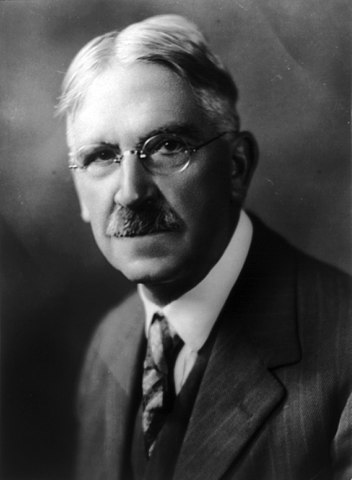
John Dewey who was the leading proponent of American pragmatism argued that an inquiry is always a response to human problems. Human beings start inquiry when they face problems, or when there are some issues that concern them, or when hurdles come in their way of realization of their desires and needs.
“We only think when confronted with a problem.”
― John Dewey
Dewey believes that problems, concerns, crisis, or hurdles causes human beings to think or to initiate an inquiry. They forces human beings to inquire about things that seem hurdle in their way of life.
This means if human beings don’t have problems, if they are at peace with themselves then there is no need for human beings to think or reflect.
Dewey tells us that human beings start to think when they find problems in things. When they see that things are not the way they want them to be, or there can be problems, crisis, obstacles, and hurdles in an individual’s own life which prompts him to think.
Problems can be of any kind, they could be intellectual or material problems. But the presence of problems is very important for the initiation of inquiries.
So, if an inquiry always begins with problems, and if it can’t be initiated without problems then this reveals something very important about human inquiry. This shows us that human thought as such, and all the intellectual discourses which include science, humanities, and social sciences are in some form or other responses to human problems.
In what sense does an inquiry a response to human problems?
Inquiries and investigations are responses to human problems in the sense that they conceive solutions to those problems, that’s why human beings in the first place reflect upon things. The purpose of thinking is to figure out solutions to those problems, to work out to eliminate the obstacles that come in their ways.

Physics, mathematics, literature, sociology, psychology and all human sciences including natural, human, and social are basically solution to human problems. They are attempts on human part to solve problems.
Human knowledge is a response to the conditions in which people find themselves where they have issues, concerns, or problems.
This means human beings can’t detach themselves from the conditions in which they find themselves. So the idea of disinterested investigation, the idea that human beings can have absolute truths is seriously undermine by this view of knowledge.
If all investigation, all thoughts, all laws are basically human attempts to solve problems then no law has universality. In other words, there are no truths.
Then what does a truth mean?
Truth is basically an attempt by human beings to solve problems. In order to eliminate problems human beings come up with ideas. When those ideas succeed in solving problems, human beings treat those ideas as true ideas.
Anything that solves human problems is considered truth.
This is the most important implication of Dewey’s account of inquiry. So, an inquiry from the beginning shows human interest, it shows human situatedness in the world.
If a theory about atomic structure says that an atom is such that there are particles like neutron, proton in the center whereas electrons revolve around it. Dewey will not consider it an absolute truth neither will he consider it a fiction. But he will tell you that this truth about atomic structure is true to us only because it solves some problems, for instance, it solves the problem of predicting atom’s behavior, and solves the problem of controlling atom.
So there are no truths in the absolute sense. The fact about atomic structure is true in the particular context. It is not true because it exist independently. There is no psychologically independent world. Even the atoms don’t have an independent existence apart from human psychology. This is the human conditions, human capacities, their needs, and their desire that constitutes a view of the world.
This is why Dewey believes that there is no psychologically independent reality. Human beings are very much shaped by their own psychology. Even the truths, even the knowledge, even the inquiries are dependent on human psychology.
This article uses direct quotes and paraphrases from one of the lectures of Dr. Zulfiqar Ali on Pragmatism. Dr. Zulfiqar Ali is an associate professor of Department of Philosophy, University of Karachi.
 Everyday Philosophy